











You're parked forty minutes from the nearest cell signal, coffee's brewing, and the plan for the day is a slow morning followed by a hike. Then you turn the key and get a weak click instead of an engine. For RV owners, that moment raises a fair question: does a portable jump starter actually earn its spot in the rig, or is it another gadget that sits untouched until it's outdated?
If you've ever shopped for a portable jump starter for car emergencies before, you've probably noticed most listings barely mention RVs at all—even though the stakes are higher once you're hauling a 30-foot rig instead of a sedan. After looking at how RV electrical systems actually behave and reading through what real campers say about waiting on roadside help in the backcountry, the case for carrying an RV jump starter turns out to be pretty strong, at least for certain kinds of travel.
Why RV Batteries Die Differently Than Car Batteries Do
A regular car has one battery doing double duty. Most RVs don't work that way, and that difference is exactly what catches motorhome owners off guard.
Dual battery systems: chassis vs. house
Drivable motorhomes carry two separate electrical systems:
- Chassis (engine) battery—starts the engine and powers the dash electronics.
- House (coach) battery bank—powers the lights, water pump, and appliances while you're parked.
The two are normally kept isolated on purpose, so draining the house bank overnight watching a movie doesn't leave you unable to start the engine the next morning. That isolation is genuinely useful day-to-day, but it also means a dead chassis battery can sneak up on you: after the rig has sat unused for a while, the house battery's charge level tells you nothing at all about the chassis side.
Diesel and cold weather raise the bar
Diesel-chassis rigs add another layer of difficulty. Diesel engines need a much stronger initial surge than gas engines because of their higher compression ratio, and cold weather makes that worse by thickening engine oil and slowing the battery's chemical reaction. A jump pack that starts a sedan easily can fall flat against a Class A with a 12-liter diesel on a cold morning. Not every battery jump pack on the market is built for an engine that large, so it pays to check the engine-size rating before assuming any unit will do.
The slow-drain problem nobody talks about
Then there's the parking problem, and nobody really talks about it: RVs that sit for weeks between trips lose charge slowly to things like propane refrigerators on electronic ignition, carbon monoxide detectors, clock displays, and security systems that stay on even when everything else is off. Older rigs with worn wiring or a marginal battery to begin with tend to lose that fight faster. By the time you're ready to leave, the chassis battery has often drained further than anyone expected—and that's exactly the gap a jump starter for RV use is meant to close.
Help is usually farther away than you think
None of this would matter as much if help were always close by. It usually isn't. Campers who boondock off-grid or stay in national forests are often far from cell coverage and even farther from a tow truck actually equipped to handle a rig that size.
RV-specific roadside plans run roughly $60–$250 a year depending on level and provider—AAA's RV-inclusive Premier membership, for example, is around $125 a year (AAA RV Roadside Assistance), while premium RV plans sit higher. Even paid members report waiting hours in remote spots, because local towers don't always prioritize the lower-paying dispatch calls that come through those plans. A jump box that fits in a storage bay solves the problem before it turns into an expensive, hours-long wait.
Who Needs an RV Jump Starter on Board?
So far this makes the case sound universal. It isn't. A portable jump starter earns its place much more clearly for some travelers than others.
RV owners who get the most value
- Full-time RVers and dedicated boondockers who camp without hookups—you're the group most likely to be genuinely out of reach when something goes wrong.
- Winter travelers and anyone based in a cold climate—low temperatures are exactly when batteries struggle most.
- Solo drivers and long-haul highway travelers—there's no travel partner to flag down another driver or share the wait.
- Owners whose rig sits parked for long stretches between trips—the slow-drain problem above is your reality.
- Diesel-chassis rigs, large-displacement Class A/C motorhomes, and truck-and-trailer setups towing a heavy load—your engine needs more cranking power than a small-car jump pack delivers.
You May Not Need One If
That said, plenty of RV owners won't reach for one often enough to justify it. You're a lower-priority buyer if:
- You mostly stay at full-hookup campgrounds with staff on site.
- Your trips are short and close to home, near towns with reliable tow service.
- You drive the rig often enough that the battery never has a chance to fade.
- You already have fast, reliable help nearby and rarely leave paved campgrounds.
A jump starter is cheap enough to still consider as backup, just not something that'll see much use in those scenarios.
What a Portable Jump Starter Actually Buys You
Once you've decided you're in the likely-to-need-it group, the next question is what you actually gain beyond a one-trick jump box.
Independence when there's no cell signal
The biggest win is independence. You don't have to wait on a stranger, a tow company, or a fellow camper with jumper cables and the patience to show you how to use them. You handle it yourself and get back to the actual trip.
Four tools in one compact unit
Most modern units do more than start engines. A single device that jump-starts the chassis battery, inflates a low tire, charges a dead phone, and lights up a dark campsite replaces four separate tools you'd otherwise need to pack—or worse, quietly skip packing.
Payback on the first remote breakdown
There's a cost angle too. RV towing is priced by a base fee plus loaded mile; even a mid-size Class B starts around an $85–$120 hook-up plus $3.50–$4.50 per mile, and a heavy Class A tow in a remote area, with after-hours and long-distance surcharges, can run into the hundreds or more. A single remote breakdown easily outpaces the cost of a jump starter that lasts for years. Even a paid roadside membership doesn't guarantee a fast response once you're well off the highway.
Storage and safety that matter in a rig
Storage space is tighter in an RV than in a regular car, which is why it helps that most of these units tuck into a cabinet, under a seat, or into an exterior storage bay without eating into gear space. And because you're working with a live battery connection, the safety features built into a good unit—reverse-polarity protection, spark-proof clamps, and overheat cutoffs—carry more weight here than they would on a device you'd only ever pull out in a parking lot.
How to Choose a Jump Starter for Your RV
With the benefits clear, the buying decision comes down to matching the device to your rig rather than grabbing whatever's on sale.
Match peak cranking power to your engine
Power is the one thing to actually get right. Match the jump starter to your engine, not to whatever's cheapest on sale—because price and engine-size rating don't always line up. A unit built for a small car won't reliably crank a 12-liter diesel on a cold morning, when the engine needs more than it would on a mild day.
How to read the specs:
- Peak amps tell you the burst current the pack can deliver; brands also publish the engine sizes (gas and liter-displacement diesel) they've rated it for. Use the engine-size rating as your primary check—"rated for up to 12.0L diesel" means far more than a bare amp number taken out of context.
- Cold Cranking Amps (CCA) measure sustained output in freezing conditions and matter most for cold-climate and diesel owners. Note that not every brand publishes CCA—some, including Buture, list peak amps plus an explicit engine-displacement rating instead. So compare the same metric across models, and when a brand only gives peak amps, rely on its stated engine-size compatibility rather than assuming the amp number alone tells you everything.
Air compressor and light you'll actually use
An air compressor is easy to forget about until you're limping into a campsite on a soft tire—a built-in 160PSI pump with preset pressure and auto shutoff handles that without a separate device. A flashlight with SOS mode is the same story: nobody thinks about it until the night they need it at a dark pull-off.
Build quality, safety, and operating temperature
Build quality matters, because this thing clips onto a live battery. A flimsy unit without real reverse-polarity or overheating protection is a safety problem—a flame-retardant label printed on the box doesn't mean much on its own.
Because RVs travel through more extreme conditions than the average commuter car, from desert summers to mountain winters, check the operating temperature range on the spec sheet. Assuming a unit will hold up in any weather is how people end up stranded by one that wasn't built for it.
The Best RV Jump Starter for Most Rig Setups: Buture Beta09
Putting those buying criteria back on the table—the right engine-size rating, a usable compressor, real safety protection, and a wide operating range—one model lines up with the checklist better than most.
If you want a single device that covers the most common motorhome and truck-and-trailer setups, the Buture Beta09 is the model worth looking at. Here's how it maps to the criteria above.
Cranking power that matches large engines
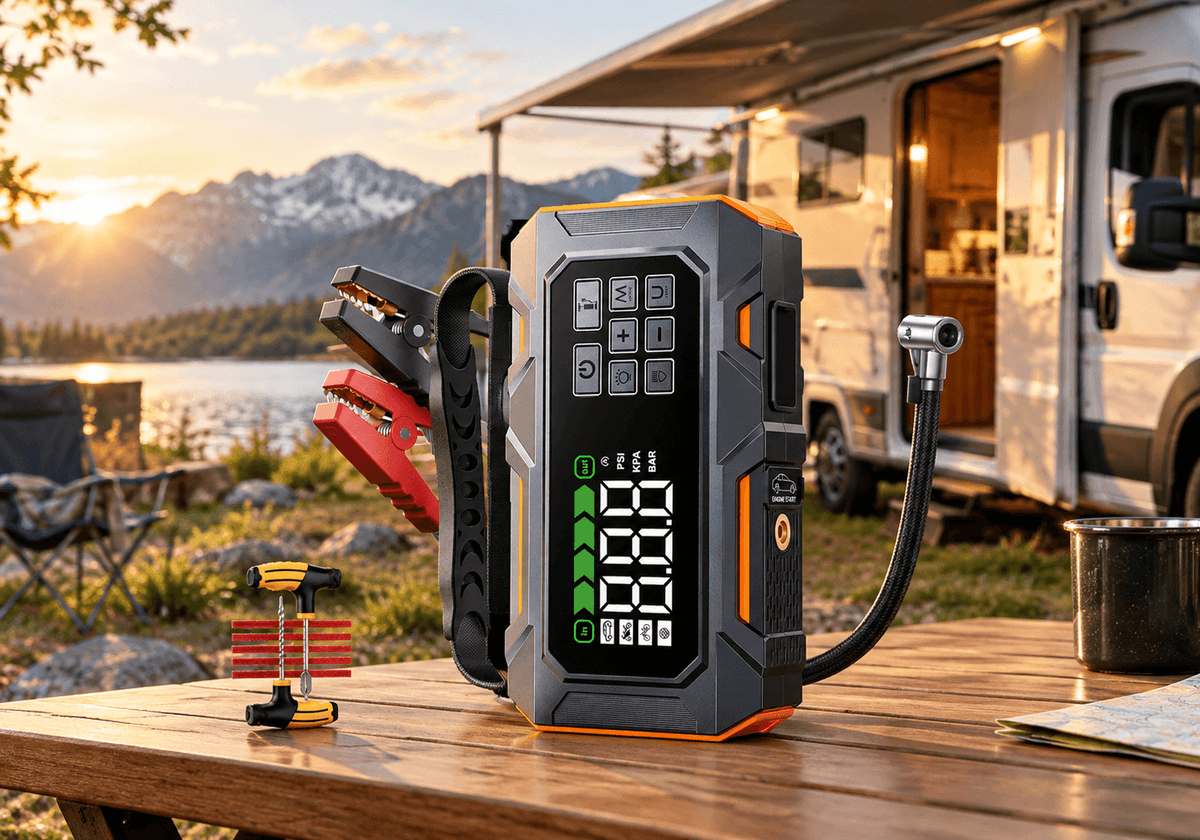
The Beta09 jump starter delivers 8,000A of peak current and is rated for all gasoline engines and diesel engines up to 12.0L, which covers most Class C and many Class A rigs, as well as heavy truck-and-trailer setups. Rather than promising it will start every engine, the honest way to read this is: it's sized for the engine-displacement range most RV owners actually run, including the cold-weather and diesel case we flagged earlier.
It also includes a Force Start mode for batteries that have drained past what a normal jump can detect. One important caveat: Force Start doesn't repair a failed or internally shorted battery—it simply lets the jump starter override its own low-voltage detection to send an assisting charge when a battery is so deeply drained that the unit would otherwise refuse to connect. That's exactly the situation a rig parked too long tends to run into, but a battery with a dead cell will still need replacing.
A 26,800mAh pack that does triple duty
The Beta09's 26,800mAh battery capacity is large enough to jump-start a vehicle dozens of times on a single charge—and to run its secondary functions, which matters when you may not have shore power to top it off between boondocks:
- 160PSI air compressor with auto shutoff—preset the PSI for your motorhome or trailer tires and it shuts off on its own, so a slow tire leak at a remote site doesn't require a separate pump.
- USB power bank—keeps phones, tablets, and cameras charged during off-grid stays.
- 5-mode LED light—from a steady work light for nighttime repairs down to an SOS signal for a roadside breakdown.
Built-in roadside kit, not a pile of loose extras
Around the unit, Buture includes a practical roadside kit: a tire repair kit, tow rope, tie-down straps, and insulated gloves—each with a real use on the road (plugging a punctured trailer tire, recovering a stuck rig, securing loose cargo, handling clamps on a live battery). The safety hammer is built into the side of the housing rather than being a separate accessory, so it's there without taking up extra pouch space. The housing is rated for an operating temperature range of −20°C to 60°C (−4°F to 140°F)—the spec to check for mountain-winter and desert-summer trips, as called out in the buying section.
Real feedback
David, a Beta09 user, puts it this way: "This jump starter (also a power bank with inflation) can jump-start dead batteries that've been discharged for years without losing power. The top 3 must-have features—light, air compression, and jump start—are all excellent. It's perfect for cold-weather or overnight battery drain, topping off tires to avoid low-pressure alerts." That lines up directly with the cold-weather and parked-too-long scenarios this article is built around.
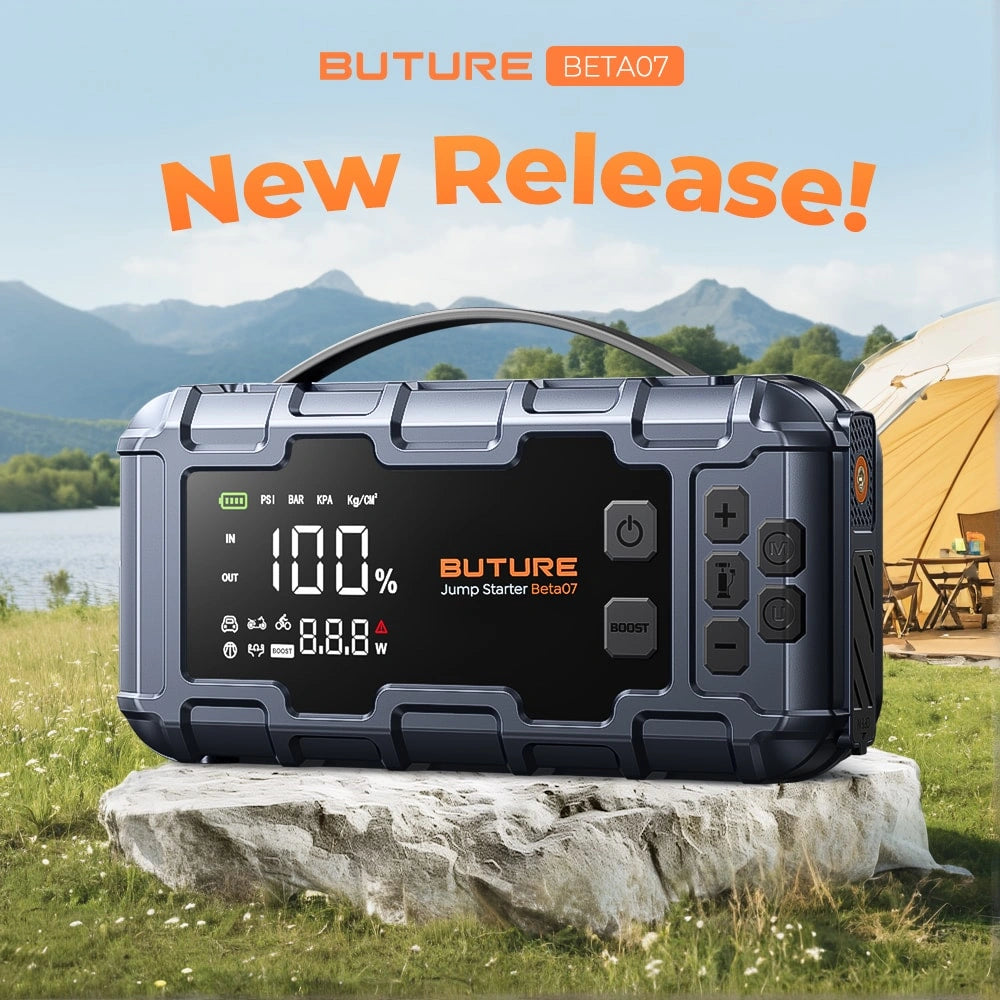
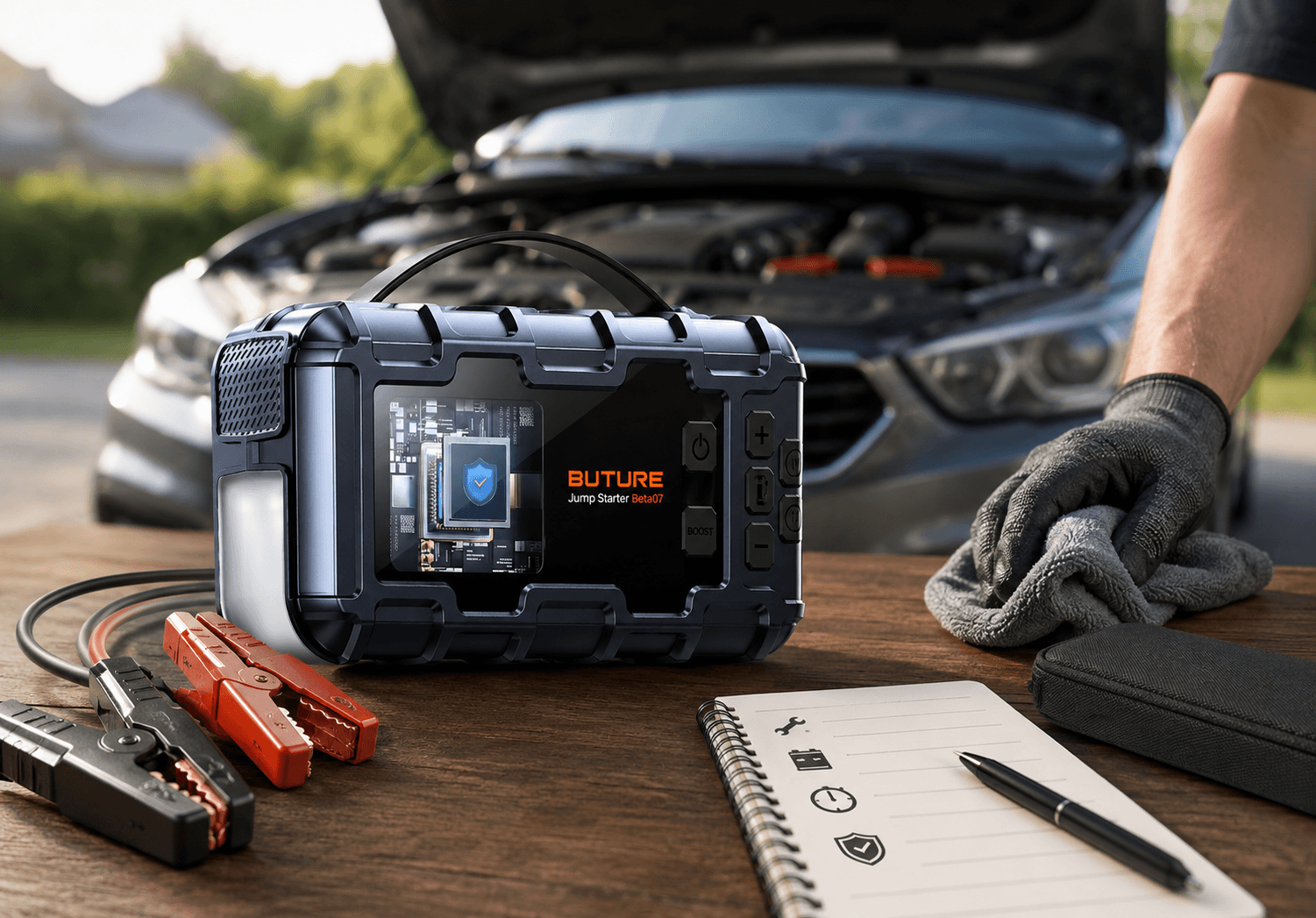
At about 2.4 lbs and roughly the size of a large paperback, it fits easily in a door pocket or small storage cubby. If your setup is smaller—a lighter gas-only tow vehicle or travel trailer—the Buture Beta07 is worth a look: 6,000A peak, a lower price, and plenty for many gas-powered rigs. You can compare both side by side in Buture's jump starter collection.
Final Verdict: Is an RV Jump Starter Worth It?
For most motorhome owners who travel off-grid, in cold weather, or far from help, a portable jump starter is one of the highest-value, lowest-fuss safety items you can stow in a storage bay. It doesn't replace proper chassis battery maintenance or a roadside plan for major breakdowns, but it closes the gap on the single most common—and most embarrassing—roadside failure: a dead chassis battery after a slow drain or cold snap.
The formula is simple: size the pack to your engine, confirm it handles your climate, and pick one that also inflates tires and charges devices. Do that, and it's the kind of gear you keep in the rig and hope you never have to use—much like the fire extinguisher.
FAQ
Can a portable jump starter really start a diesel RV engine?
Yes, but only if it's actually rated for diesel. Diesel engines take more effort to start than gas engines, especially when cold. Before you buy, check that the jump starter lists a diesel engine-displacement rating (e.g., "up to 12.0L diesel"), not just a high peak-amp number on the box.
Will a jump starter work on a battery that's been sitting dead for months?
It depends on how dead the battery really is. Most jump starters bring back a battery that's just low. If it's been sitting for months and is almost completely flat, look for a model with a Force Start or boost mode—which helps the unit send an assisting charge despite ultra-low voltage. Note that this won't revive a battery with a failed internal cell; that still needs replacing.
Can I use my jump starter to inflate my RV's tires, or just my tow vehicle's?
Most built-in air compressors work on any standard valve—car, trailer, bike, or sports ball—as long as you have the right nozzle. Preset pressure and auto shut-off help prevent overinflating a smaller tire.
Does a jump starter lose its charge if I leave it in storage all winter?
Lithium units hold a charge far longer than older lead-acid jump packs, often for months between charges. Still, check the charge level a couple of times a season—especially before a cold-weather trip, when you're most likely to need it.
Do I need a separate jump starter for the chassis battery and the house battery?
No. A portable jump starter connects to whichever battery needs the boost—most commonly the chassis battery, since that's what starts the engine. The house battery bank runs on a different system and typically doesn't need jump-starting the way a starting battery does.
Is it safe to connect a jump starter to a lithium RV battery?
Generally yes, but check your battery manufacturer's guidance first—lithium battery management systems handle external charging a little differently than lead-acid. A jump starter with reverse-polarity and overcurrent protection reduces the risk either way.
How much should I plan to spend on one for RV use?
Most reliable units sized for RV engines land between $100 and $200. Cheaper options usually mean giving up peak cranking power, safety protections, or extras like an air compressor—all of which matter more on an RV than on a small commuter car in a driveway.

Buture JR500 Cordless Vacuum Cleaner | 450W 33KPA

Buture VC60 Cordless Vacuum | 450W 38KPA




Leave a comment
This site is protected by hCaptcha and the hCaptcha Privacy Policy and Terms of Service apply.