










Introduction
A dead car battery is one of the most common and frustrating roadside issues every driver faces. Whether you leave your headlights on overnight or deal with an aging battery that can no longer hold a charge, a stalled vehicle can ruin your commute, road trip, or daily schedule. Portable car jump starters, also widely known as jump boxes, jump packs, or battery jumper devices, have become essential roadside gear to solve this problem without relying on another vehicle’s battery.
Despite their convenience and reliability, most users overlook regular battery maintenance and proper usage habits. Simple neglect can drastically shorten the lifespan of even high-quality jump starters. This comprehensive guide is designed to help all car owners understand jump starter battery characteristics, master professional maintenance routines, avoid harmful usage mistakes, and maximize the service life of their portable jump starter devices. By the end of this guide, you will know exactly how to care for your jump pack to keep it functional and reliable for years.

Understanding Jump Starter Battery Types
Lithium-Ion vs Lead-Acid Jump Pack: Pros & Cons
Two primary battery types power consumer-grade jump packs: lead-acid and lithium-ion batteries, and their performance differences directly determine device lifespan, portability, and usability. Traditional lead-acid jump boxes are affordable but come with obvious drawbacks. They are bulky, extremely heavy, have low energy density, and feature a limited charge-discharge cycle life. Additionally, lead-acid models struggle to deliver stable high peak current in extreme temperatures, making them unsuitable for modern emergency roadside use.
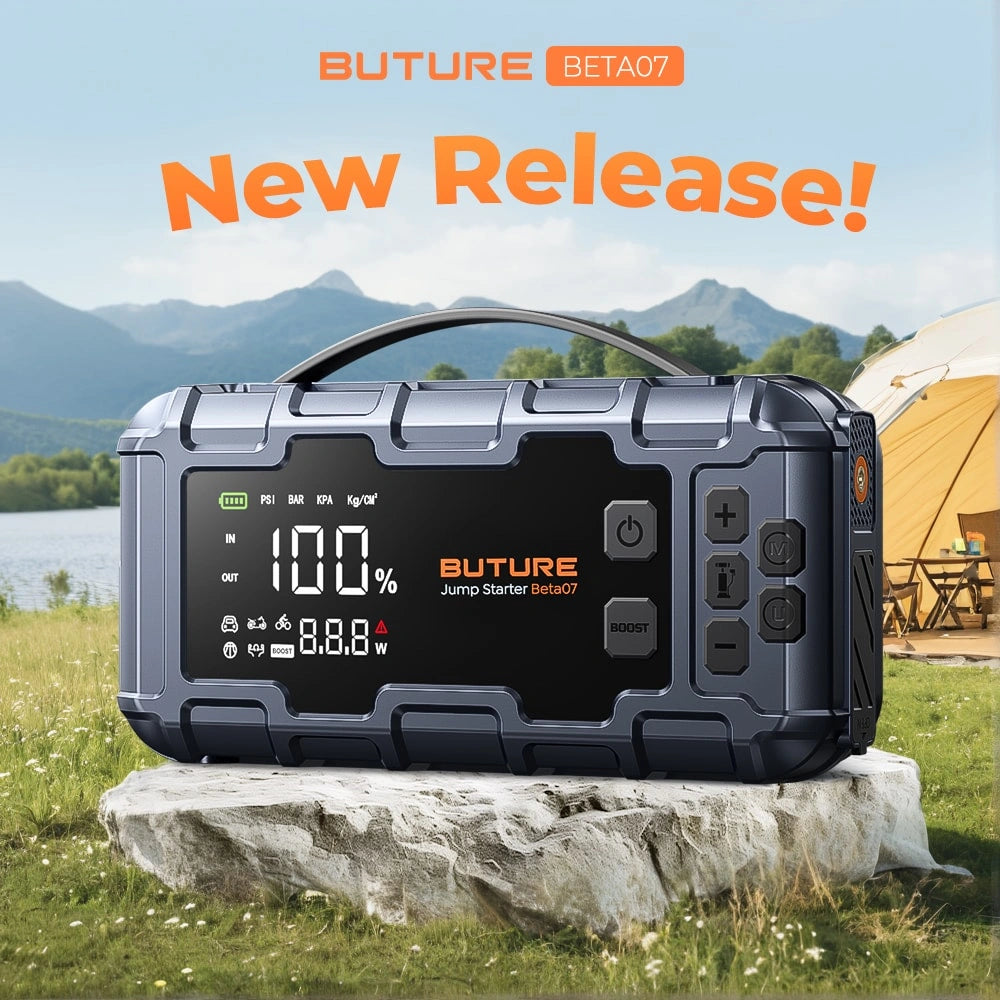
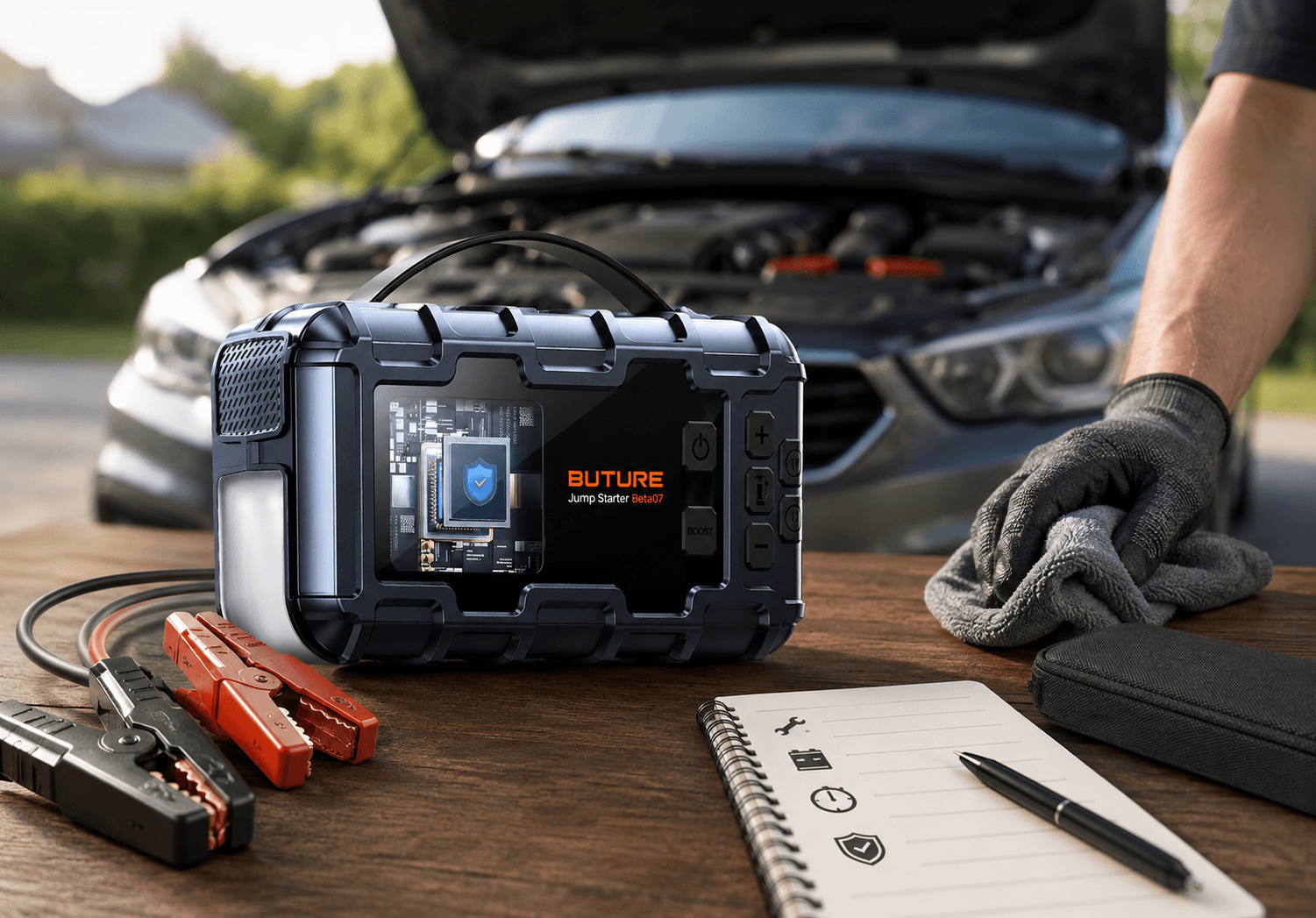
In contrast, lithium-ion jump starters dominate the current market for their balanced advantages. They are lightweight, compact, and capable of outputting strong, stable cranking power while boasting far longer cycle lifespans. Premium Buture jump starter models, such as the Beta07 and Beta09, adopt high-grade lithium-ion battery cells as their core power source. This advanced battery configuration allows these devices to deliver consistent starting performance, support multiple jump starts per single full charge, and maintain better long-term durability than traditional lead-acid jump packs.
Battery Capacity, Chemistry and BMS in Portable Car Jump Starters
Battery capacity, measured in mAh, reflects the total power storage of a portable car jump starter and decides how many emergency jump starts the device can provide on one charge. Buture Beta04 jumper box features a 26800mAh large-capacity battery, which offers ample power reserve for repeated emergency use and daily device charging.
Beyond basic capacity and battery chemistry, the Battery Management System (BMS) is the core protective component of every reliable portable jump starter. The intelligent BMS built into Buture jump starter products monitors cell voltage, temperature, and current in real time. It effectively prevents overcharging, deep discharge, overheating, short circuits, and overload operation. This smart protection mechanism avoids irreversible damage to internal battery cells, laying a solid foundation for extending the overall lifespan of the jump box.
Average Lifespan of a Portable Jump Starter
Charge Cycle Life of Lithium Battery Jump Starters
The service life of lithium battery jump starters is mainly defined by their full charge-discharge cycle life. Standard consumer lithium-ion jump packs support 300 to 500 complete charge and discharge cycles under standard operating conditions. Each full drain and full recharge counts as one complete cycle.
High-quality models like the Buture Beta07 and Beta09 jump starters use premium customized lithium cells, which maintain stable performance even after hundreds of cycles. However, frequent deep discharges—draining the battery to 0% power—will rapidly consume cycle times, accelerate cell aging, and greatly reduce the effective service life of the battery jump starter. Gentle charge and discharge habits can fully release the cycle life potential of high-grade lithium batteries.
How Unused Jumper Boxes Degrade Over Time
Even if you never use your jumper box, its internal battery will still age gradually over time, a phenomenon known as calendar aging. No lithium-ion jump starter can maintain 100% performance permanently while sitting idle. For most mainstream portable jump starters, the average effective service life is 3 to 5 years under normal storage and usage conditions.
Typical aging signs include prolonged charging time, reduced peak cranking amps, inability to hold a full charge for long, and failure to start vehicles that the device could easily power before. Even well-maintained idle jump packs will experience slow chemical attenuation of internal battery cells, leading to inevitable performance degradation after several years.
Core Factors That Shorten Your Car Battery Jump Starter Lifespan
Charge and Discharge Habits That Impact Battery Jump Starter Health
Daily charge and discharge habits are the most influential daily factor affecting the lifespan of a car battery jump starter. The biggest enemy of lithium-ion jump packs is deep discharge. Long-term storage or repeated use with battery power below 20% will cause irreversible chemical damage to internal cells, reducing battery capacity and peak power output permanently.
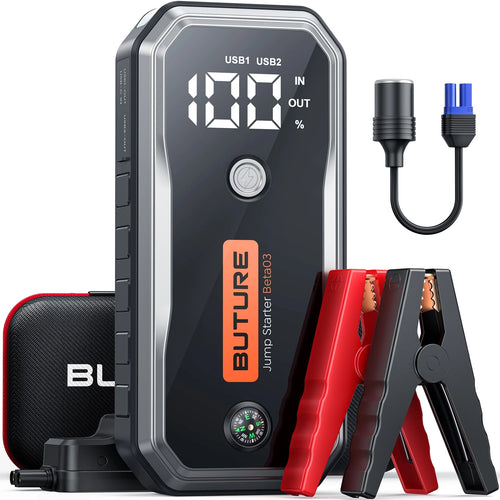
Partial charge and partial discharge are far gentler for lithium batteries than full cycle operation. For daily use, you do not need to drain the jump starter completely before recharging. Models like the Buture Beta03 and Beta06 jump starters support flexible partial charging, and maintaining a battery level between 20% and 80% for daily storage can effectively slow down cell aging and preserve long-term battery activity.
How Extreme Temperatures Damage Jump Boxes
Extreme high and low temperatures are major silent killers of portable jump boxes. High ambient heat accelerates the chemical reaction speed inside lithium batteries, triggering rapid cell degradation, capacity loss, and even hidden safety hazards. Leaving your jump starter on a car dashboard or in a closed trunk in hot summer weather will drastically shorten its service life.
Extreme low temperatures do not cause permanent battery damage but will temporarily reduce battery activity and peak output power. In ultra-cold environments below -4°F (-20°C), most ordinary jump starters struggle to deliver stable cranking power. Premium Buture jump starter models like Beta09 adopt optimized low-temperature battery algorithms, which can maintain stable starting performance in cold weather, but long-term low-temperature storage will still accelerate overall aging and should be avoided.

How Internal Cell Quality Affects Jump Pack Durability
The quality of internal battery cells fundamentally determines the durability and lifespan of a jump pack. Low-cost generic jump starters use inferior recycled battery cells, which have unstable chemical properties, poor temperature resistance, and extremely short cycle life, often aging significantly within 1 to 2 years.
Buture car jump starter series adopt brand-new high-density lithium cells with strict quality screening. The Beta07 delivers 6000A peak current, while the upgraded Beta09 reaches 8000A peak current. These premium cells feature stable discharge performance, strong overload resistance, and longer cycle life. Coupled with intelligent BMS protection, high-quality cell configurations enable Buture jump starters to maintain stable performance throughout their 3–5 year service cycle, far exceeding the durability of ordinary generic jump boxes.
Essential Routine Maintenance for Jump Starters
Best Storage Conditions for Portable Car Jump Starters
Scientific storage is the simplest and most effective way to extend the life of a portable car jump starter. The ideal storage environment is a cool, dry, and well-ventilated space with a constant temperature between 50–77°F (10–25°C). This temperature range perfectly matches the optimal working and storage temperature of lithium-ion jump starter batteries.
Avoid storing your jump box in humid garages, outdoor open spaces, or car interiors. High humidity will cause corrosion on metal terminals and clamps, while unstable temperature fluctuations will accelerate battery aging. For long-term storage of Buture jump starters, users should choose indoor dry storage spaces, avoid direct sunlight and moisture erosion, and lay a solid foundation for long-term stable operation of the equipment.

Recommended Recharging Schedule for Idle Portable Jump Starters
Most users only charge their portable jump starters when they need to use them, which is a wrong maintenance habit. Lithium-ion batteries will automatically lose power slowly during idle storage. Long-term low-power idle state will lead to deep discharge damage and permanent capacity attenuation.
The universal maintenance rule is to recharge idle portable jump starters every 3 to 6 months. For high-capacity models like Buture Beta07 and Beta09 with 26800mAh batteries, quarterly supplementary charging is the most scientific cycle. Always use the certified 5V/2A charger for charging. Do not use uncertified fast chargers casually, as mismatched fast charging protocols will increase battery load and accelerate cell aging.
Visual Inspection & Terminal Cleaning for Jumper Boxes
Regular visual inspection and terminal cleaning are essential daily maintenance steps for jumper boxes, which can effectively avoid equipment failure caused by corrosion and physical damage. Users should regularly check the appearance of the jump starter, focusing on whether there are bulging casings, surface cracks, worn cables, or deformed connectors.
For metal clamps and charging terminals that are frequently used and exposed to the air, dust and electrochemical corrosion will accumulate after long-term use, affecting current transmission efficiency and even causing circuit poor contact. You can prepare a mixed solution of baking soda and clean water to wipe the corroded parts, then dry the terminals completely with a dry cloth. The spark-proof smart clamps equipped on Buture Beta07 and Beta09 jump starters have strong anti-corrosion performance, but regular cleaning can further extend the service life of the clamps and ensure safe and stable starting operation.
Best Usage Practices to Expand Jump Box Lifespan
Correct Jump-Starting Procedure for Car Jump Starters
Standardized jump-starting operation can effectively avoid excessive load damage to the jump box and extend its overall service life. When using a car jump starter to start a vehicle, do not perform continuous frequent starting attempts. It is recommended to limit starting attempts to 3 to 5 times at most in a single operation.
If the vehicle fails to start successfully, stop the operation immediately and let the jump starter cool down completely. Continuous high-current output will generate a lot of heat inside the device, which will damage the battery cells and circuit board in the long run.

Match Your Jump Pack Power to Your Vehicle Engine Size
Using a jump pack with mismatched power is a key cause of premature battery aging. An underpowered jump starter will be in a long-term overload state when starting large-displacement vehicles, resulting in excessive current load, severe heat generation, and accelerated cell attenuation.
Users need to select a jump starter according to their vehicle’s engine type and displacement. The Buture Beta07 jump starter with 6000A peak current is suitable for all gasoline engines and most diesel engines up to 12L, perfectly matching daily family cars, SUVs, and ordinary pickup trucks. The upgraded Buture Beta09 jump starter with 8000A peak current provides stronger power reserve, more suitable for large SUVs, heavy-duty diesel vehicles, and RVs. Matching the correct power model can avoid equipment overload and effectively extend the service life of the jump pack.
Post-Use Care Rules for Portable Car Jump Starters
Scientific post-use care is crucial to maintaining the battery activity of portable car jump starters. Many users habitually store the jump starter directly after use with residual low power, which is extremely harmful to lithium batteries. After each jump-start operation, no matter how much power remains, you should recharge the device to a sufficient level in a timely manner.
Never store a drained or low-power jump starter for a long time. Timely recharging can keep the battery cells in a stable active state, avoid deep discharge aging, and ensure the device can respond to emergency needs at any time. This simple post-use maintenance habit can double the effective service life of jump starter battery.
Common Mistakes That Ruin Your Jump Starter
Risks of Leaving Portable Jump Starters Permanently Plugged In
Many users think that modern jump starters have BMS overcharge protection and can be plugged in permanently, which is a typical wrong cognition. Although the intelligent BMS of Buture jump starters can cut off the charging circuit after full power to avoid overcharging damage, long-term plug-in standby will produce continuous residual heat inside the equipment.
Persistent heat accumulation will slowly erode lithium battery cells, accelerate chemical aging, and reduce battery activity and capacity over time. For long-term maintenance, you must unplug the charger in time after the jump starter is fully charged, and avoid 24/7 plug-in standby, so as to effectively protect the battery health of the jump box.
Why You Should Not Store a Jump Box Inside Your Vehicle
Storing a jump box in the car trunk or glove box all year round is one of the most common mistakes that damage portable jump starters. The interior environment of the vehicle has extremely severe temperature changes. The temperature inside the car can soar to over 122°F (50°C) in summer and drop to below freezing in winter.
Frequent and drastic temperature swings will cause repeated expansion and contraction of lithium battery cells, destroy the internal chemical balance, and greatly accelerate aging. Even high-quality models like Buture Beta07 and Beta09, which have excellent temperature resistance, cannot resist long-term extreme temperature cycle damage. Therefore, indoor constant-temperature storage is always the best choice for jump starter maintenance.
Environmental Tips & Proper Jump Starter Disposal
How to Recycle Lithium-Ion Car Battery Jump Starters
Lithium-ion car battery jump starters belong to electronic waste and cannot be discarded directly in household garbage. Waste lithium batteries will cause environmental pollution and also have potential safety hazards. When your jump starter reaches the end of its service life after 3–5 years of use, you need to handle it through formal recycling channels.
You can find local certified e-waste recycling stations or professional lithium battery recycling institutions for centralized harmless treatment. Whether it is ordinary jump packs or high-end Buture jump starters, standardized recycling is the only correct way to dispose of waste equipment, complying with environmental protection regulations and avoiding resource waste.

Reduce E-Waste by Maximizing Portable Jump Starter Lifespan
Extending the service life of portable jump starters through scientific maintenance is the most effective way to reduce electronic waste. Every year, a large number of intact jump starters are scrapped early due to improper maintenance and wrong usage habits, causing huge waste of resources and environmental pressure.
By mastering standardized storage, charging, and usage methods, users can maximize the service life of equipment such as Buture jump starters. A well-maintained jump starter can maintain stable performance for 4–5 years, effectively reducing the frequency of equipment replacement, cutting down electronic waste generation, and realizing eco-friendly daily use of automotive emergency equipment.
Conclusion
The lifespan of a car jump starter is never fixed. It depends entirely on daily maintenance, usage habits, and storage conditions. High-quality portable jump starters like Buture Beta07 and Beta09 have excellent hardware quality and intelligent BMS protection, laying a good foundation for long-term use. However, only with scientific and standardized care can their performance advantages be fully exerted.
The core secrets of extending jump starter lifespan are stable temperature storage, avoiding deep discharge, regular supplementary charging, standardized starting operation, and abandoning wrong usage habits. Simple daily maintenance can effectively avoid premature aging of the battery and double the effective service life of the jump box.
It is recommended that all users set a calendar reminder to charge their portable jump starter every 3 months to ensure the battery remains active for a long time. A well-maintained jump pack will always be your reliable roadside emergency helper. If you have practical jump starter maintenance tips, welcome to share them in the comment area!
【Flash Sale】Buture VC70 Cordless Vacuum Cleaner | 450W 38KPA

Buture JR500 Cordless Vacuum Cleaner | 450W 33KPA



Leave a comment
This site is protected by hCaptcha and the hCaptcha Privacy Policy and Terms of Service apply.