














Your car fails to start out of the blue, leaving you stuck wondering whether to grab a jump starter or a battery charger. Though both tools fix dead car batteries, they work in entirely separate ways and fit different needs: jump starters deliver instant burst power to fire up your vehicle right away as an emergency fix, while battery chargers slowly replenish battery juice to extend overall battery lifespan for long-term maintenance.
Knowing which device to use in various situations can save you time, money, and hassle. Below we compare the main difference between a jump starter and a battery charger to help you confirm which option you truly need and decide if adding both to your vehicle toolkit is worthwhile.
What Is a Jump Starter?
A jump starter is a portable, cordless, high-powered device designed to provide a burst of power to the battery, allowing the car engine to turn over and start. Unlike traditional jumper cables that rely on another running car, a portable jump starter is a self-contained power pack that stores power internally. It delivers an instant, high-current power burst to crank your engine within seconds.
It is important to clarify one key point: a jump starter cannot fully charge a car battery. It only provides temporary power to start the engine. Once the car is running, the vehicle’s alternator takes over to charge the battery. Jump starters are made for emergencies, not long-term battery maintenance.

How Car Jump Starters Work
The working principle of a jump starter is simple and user-friendly, requiring no professional skills:
First, the jump starter stores stable power in its built-in lithium battery. When your car battery dies, connect the smart insulated clamps of the jump starter to the positive and negative terminals of your car battery. Most modern jump starters feature reverse polarity protection, avoiding wrong connection damage.
After successful connection, the device releases a short, powerful peak current burst. This instant high power drives the car’s starter motor and ignites the engine. After the engine starts, disconnect the jump starter, and the car’s alternator will continuously replenish power to the vehicle battery during driving.
The whole process takes only a few minutes, making it the fastest solution for sudden dead battery breakdowns.
Types of Battery Jump Starters
Jump starters on the market are mainly divided into three types, suitable for different usage needs:
Portable Lithium Jump Starters
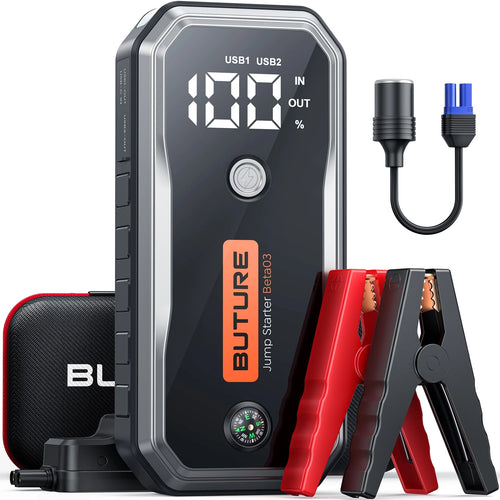
This is the mainstream type for household and personal use, adopted by most Buture models. It features ultra-lightweight, compact size, low self-discharge rate, and strong temperature resistance. It is easy to store in car trunks or glove boxes, with stable performance for sedans, SUVs, and small trucks.
Traditional Lead-Acid Jump Starters
This is an old-generation model with low cost but obvious drawbacks. It is bulky and heavy, slow to charge, and loses power easily after long-term storage. It is mostly used for professional engineering vehicles and is not suitable for daily portable emergency use.
Multi-Functional Combo Jump Starters
An upgraded all-in-one model that integrates multiple functions. Besides jump starting, it is equipped with an air compressor, LED emergency light, USB fast charging, and other practical functions. It perfectly meets road trip, emergency rescue, and daily mobile phone charging needs, being the most cost-effective choice for family vehicles.
What Is a Battery Charger?
A battery charger is a device that is designed to help you safely and efficiently restore energy to your car battery. Unlike jump starters that give an instant boost, a battery charger is a slow process of giving your battery the energy it needs to be filled with power over time.
Functions of Car Battery Chargers
A battery charger plugs into a normal wall socket and your car’s battery. Once plugged in, it charges the battery at a controlled rate. This steady, slow charging process is safer than a sudden power surge, since your battery can now make a steady recovery without damage.
Its core functions include three parts: First, full battery recovery. It can deeply charge severely depleted batteries that cannot be repaired by vehicle alternators, restoring the battery’s full capacity. Second, intelligent maintenance protection. High-quality chargers have trickle charging and automatic power-off functions. They stop charging automatically when the battery is full and supplement power intelligently when power is lost, preventing overcharging and battery aging. Third, long-term standby care. For vehicles, motorcycles, and RVs that are parked for a long time, a battery charger can maintain battery activity and avoid scrapping caused by long-term power loss.

Benefits of Using a Vehicle Battery Charger
Equipping a battery charger brings long-term benefits for vehicle owners:
- Extend battery: service life Long-term undercharging is the main cause of battery aging and damage. Regular slow charging with a charger repairs battery loss, delays aging, and greatly prolongs battery service life.
- Save replacement costs: A qualified car battery costs hundreds of dollars. Regular maintenance with a charger avoids frequent battery replacement and saves long-term vehicle maintenance costs.
- Improve vehicle startup stability: A fully maintained battery ensures stable startup in low-temperature environments and avoids startup failure caused by insufficient battery power in winter.
Wide compatibility It is suitable for all 12V lead-acid, AGM, and lithium batteries, covering cars, motorcycles, yachts, and RVs, with strong versatility.
What's the Difference Between Jump Starters and Battery Chargers?
Most car owners confuse jump starters and battery chargers, but their differences in function, efficiency, portability, and safety are very obvious. We analyze them in four core dimensions:
Purpose and Functionality
Jump Starter: Emergency rescue tool. Core purpose is to start the car instantly. It outputs instantaneous high current to crank the engine, with no battery repair or charging function. It solves the problem of "cannot start the car right now".
Battery Charger: Maintenance and repair tool. Core purpose is to restore battery capacity. It charges the battery slowly and repairs power loss and aging problems, solving the problem of "poor battery health".
Charging Time and Efficiency
Jump Starter: Extremely high emergency efficiency. It can start the car successfully in 3-10 seconds. But it cannot charge the car battery; the jump starter itself only needs 1-3 hours to be fully charged for standby.
Battery Charger: Slow and stable maintenance efficiency. It takes 4-12 hours to fully charge a depleted car battery. The charging process is continuous and stable, focusing on charging quality rather than speed.
Portability and Convenience
Jump Starter: Super portable and flexible. Cordless and compact, it can be carried in the car at all times, suitable for roadside, travel, and outdoor emergency scenarios with no power supply.
Battery Charger: Poor portability. It needs to be plugged into household AC power, with wired design and large volume. It can only be used in fixed scenarios such as homes and garages, unable to cope with outdoor sudden failures.
General Safety Considerations
Jump Starter Safety: Modern portable jump starters have comprehensive safety protection mechanisms, including reverse polarity protection, short circuit prevention, overheat protection, and spark-proof design. The operation is simple and safe, and novices can use it without risk.
Battery Charger Safety: The charging time is long, requiring placement in a ventilated environment. Low-quality chargers have risks of overcharging and overheating. It needs manual inspection during long-time charging to avoid battery damage.
Jump Starter vs Battery Charger: Which Should You Choose?
There is no absolute good or bad between the two tools, only suitable or unsuitable scenarios. You can make a choice according to your daily car use needs:
When a Jump Starter Is Needed
Every family car owner must prepare a jump starter, which is the most practical emergency tool for daily driving:
- Often drive out, travel self-driving, or park the car in outdoor parking lots for a long time
- Often forget to turn off lights, air conditioners, and on-board electrical appliances, easily causing battery drain
- Live in low-temperature areas where batteries are prone to power loss and startup failure in winter
- No professional garage maintenance conditions, need self-rescue for sudden dead battery failures
In short, if you want to solve sudden dead battery problems quickly and avoid being stranded on the road, a jump starter is your first choice.
When a Car Battery Charger Is Needed
Battery chargers are more suitable for long-term vehicle maintenance scenarios:
- Vehicles are parked for a long time and not driven for months, such as seasonal cars and RVs
- Have high requirements for battery health and want to extend battery service life
- Family has multiple vehicles, motorcycles, and electric equipment that need regular battery maintenance
- The car battery is aging and often undercharged, requiring regular repair and activation
It is recommended that professional car maintenance users and multi-car families equip a battery charger for daily maintenance.
Buture Jump Starter Top Picks for Your Car
As a professional automotive emergency tool brand, Buture’s jump starters are famous for high power, stable performance, and multi-functional design. Here are some cost-effective series suitable for most car owners:
High-power Car Jump Starter
Buture high-power jump starters are designed for large-displacement vehicles, SUVs, and trucks. With ultra-high peak current output, they can easily start all 12V gasoline and diesel vehicles, even in extreme low-temperature environments.
Buture Beta04 car jump starter adopts upgraded lithium battery cells, with stable power output, low self-discharge, and long standby time. It is equipped with full safety protection systems to avoid wrong connection and short circuit risks. In addition to jump starting, it also supports USB fast charging, which can charge mobile phones and tablets, integrating emergency rescue and daily use. It is the best choice for users with large vehicles and harsh driving environments.
Jump Starter with Air Compressor
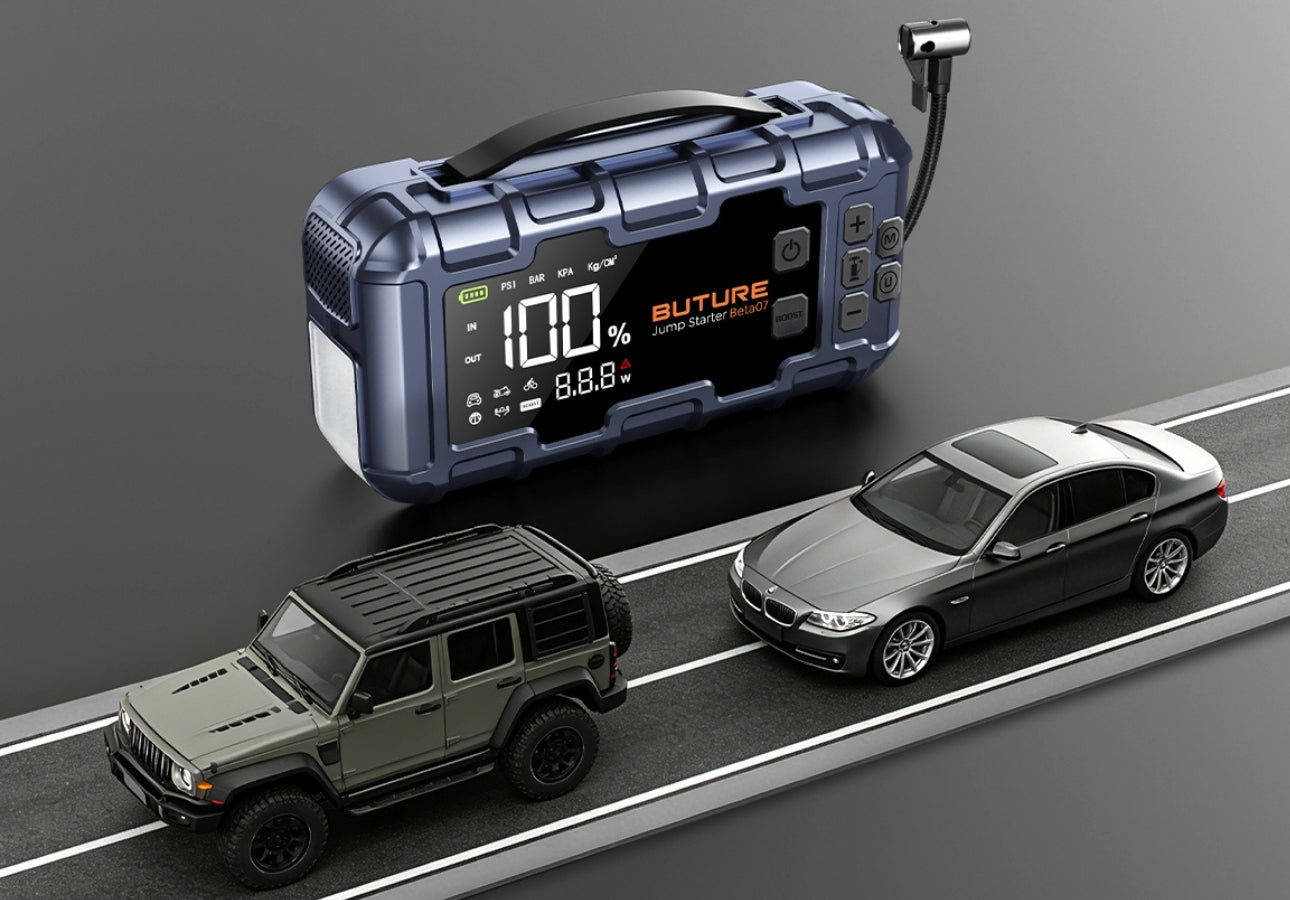
Buture multi-functional jump starter with air compressor is the most popular all-in-one model for family cars. It perfectly integrates four core functions: car jump starting, tire inflation, devices charging and emergency lighting.
Facing daily tire deflation and road trip tire pressure insufficient problems, the built-in high-precision air compressor can quickly inflate tires and monitor tire pressure in real time. The bright LED emergency light supports long-term lighting and strobe warning, suitable for night rescue and roadside warning. Compact and portable, it does not occupy car trunk space, solving multiple driving troubles with one device, and is extremely cost-effective for daily family cars and self-driving travel enthusiasts.

Our recommendations:
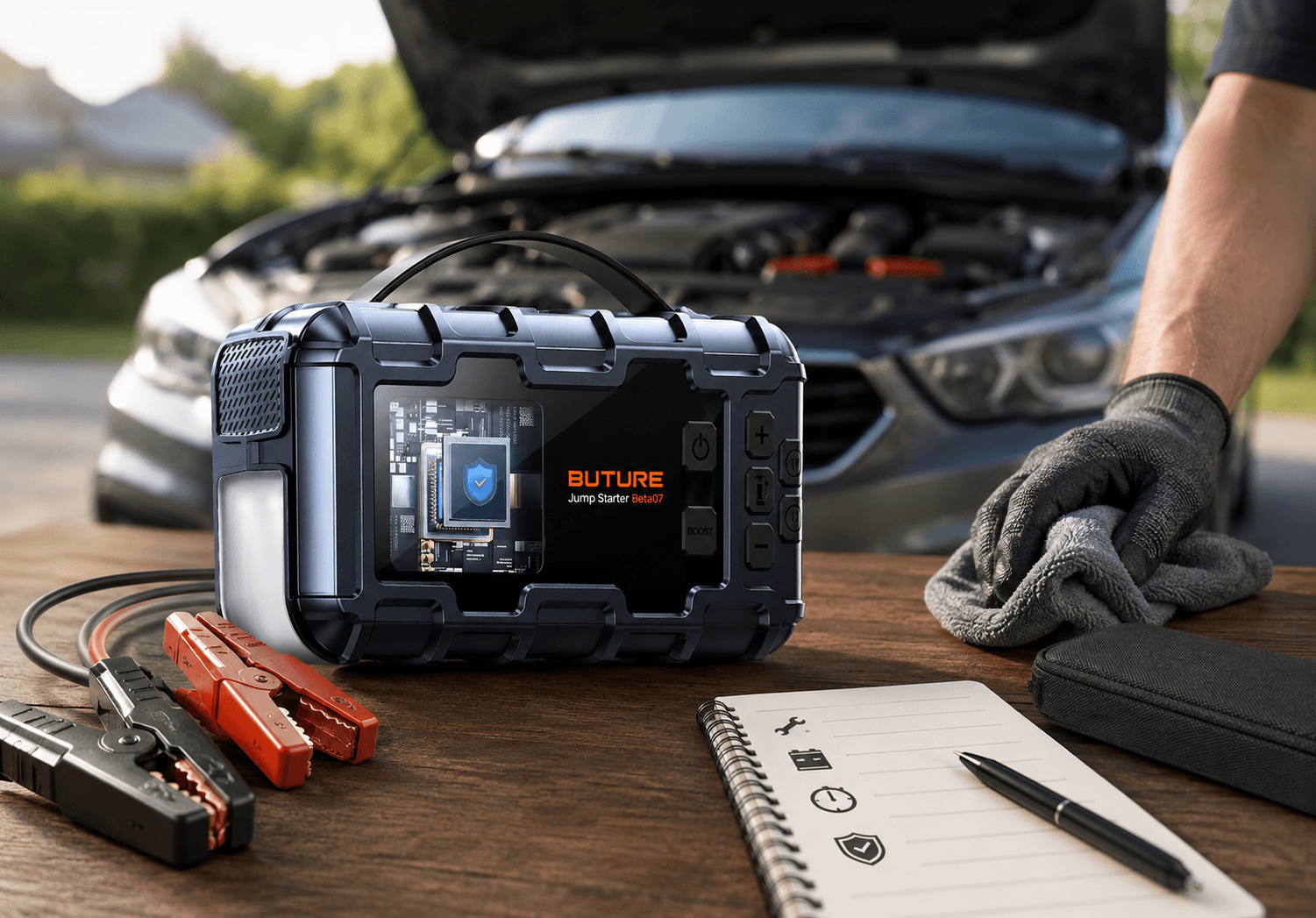
- Buture Beta07 jump starter: 6000A peck current, 160PSI smart inflating, PD45W fast charging, four-mode led lights.
- Buture Beta09 jump starter: 8000A utra-powerful start, 26800mah large battery capacity, comes with multi roadside tools (eg. tow rope, luggage binding straps, tire repair kit)
- Buture Beta01 jump starter: 3500A peak, 150PSI air pumping, small size, portable design, easy-to use.
How to Maintain Jump Starters and Battery Chargers?
Good daily maintenance can greatly extend the service life of jump starters and battery chargers, ensuring stable performance in emergency scenarios.
Caring for a Car Jump Starter
1. Regular supplementary charging: Jump starters will lose power slowly during standby. It is recommended to charge it fully every 2-3 months to avoid battery damage caused by long-term power loss.
2. Avoid extreme environments: Do not place it in high-temperature car interiors or humid and rainy environments for a long time to prevent cell aging and circuit failure.
3. Standard operation: Disconnect the clamps in time after starting the car, do not connect them for a long time, and avoid repeated frequent startup in a short time.
4. Keep clean: Regularly clean the dust and dirt on the clamps and surface to ensure good contact and stable power output.
Caring for a Battery Charger
1. Ventilated storage: After use, place the charger in a dry and ventilated environment, avoid damp and dusty places to prevent circuit short circuit.
2. Avoid overcharging: Do not charge the battery for a long time after it is fully charged. Use the trickle maintenance mode for long-term parked vehicles.
3. Protect the power cord: Avoid dragging and squeezing the power cord to prevent wire breakage and leakage risks.
4. Regular inspection: Regularly check whether the interface and circuit are aging, and stop using it in case of abnormal heat and failure.
Conclusion
A jump starter and a battery charger serve different purposes. A battery charger slowly restores a depleted battery, while a jump starter provides instant power to start a vehicle with a dead battery. Both are useful tools, but a portable jump starter is often the best choice for unexpected roadside emergencies. Always follow proper safety instructions when using either device.
Since dead batteries can happen anytime and anywhere, keeping a reliable jump starter in your vehicle is a smart way to stay prepared. Explore Buture's collection of car jump starters and be ready for any battery emergency on the road.
FAQs
Can a jump starter fully charge a car battery?
No. A jump starter only provides instantaneous high power to start the engine. It cannot fully replenish the car battery’s capacity. After startup, the car’s alternator or a dedicated battery charger is required to complete formal charging.
What are the key differences between a jump starter and a battery charger?
A jump starter is designed to provide a quick boost of power to a dead battery, allowing you to start your vehicle and get back on the road. A battery charger, on the other hand, is designed to slowly charge a battery over time, helping to maintain its health and extend its lifespan.
Can you use a battery charger to start a dead battery?
Not immediately. A battery charger cannot provide the instant emergency boost that a jump starter can. Instead, it slowly recharges a depleted battery over several hours or overnight. If you need to get back on the road quickly, a jump starter is the better tool.
Which is better: jump starter or battery charger?
It depends on your goal. Choose a jump starter if you want fast emergency starting power for dead batteries. Choose a battery charger if you want to recharge, restore, or maintain a weak battery over time. If you want both roadside emergency protection and long-term battery maintenance, owning both is ideal.
Is a jump starter with an air compressor worth buying?
Absolutely yes. The all-in-one design integrates jump starting, tire inflation, and emergency lighting, avoiding the need to carry multiple tools. It is cost-effective and space-saving, being the most practical choice for family cars and self-driving tours.
Is it safe to leave a jump starter in the car all the time?
Modern portable lithium jump starters like Buture are safe for long-term car storage, with built-in overheat, short-circuit, and over-discharge protection. However, avoid placing them in high-temperature enclosed car interiors in summer or extremely humid environments for a long time, which can extend the device’s service life and ensure stable performance.
Buture VC80 Cordless Vacuum Cleaner | 450W 40KPA
![Buture Beta01 Smart Jump Starter 3500A with Air Compressor [4-in-1]](http://ibuture.com/cdn/shop/files/buture-beta01-car-jump-starter.jpg?v=1748248782&width=500)


Leave a comment
This site is protected by hCaptcha and the hCaptcha Privacy Policy and Terms of Service apply.